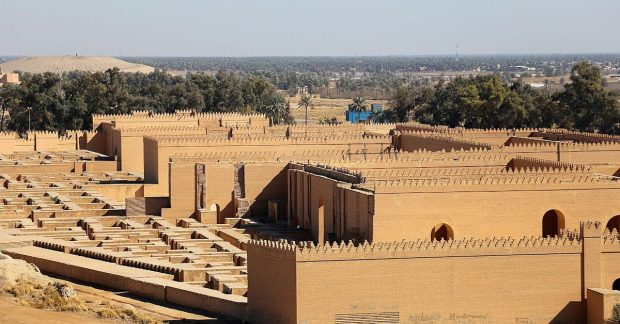
Scientists determine the precise date of the fall of ancient Babylon
An international research team has established a new chronology for the fall of Babylon by combining tree-ring analysis with volcanic activity data.
 🎭Culture & Sport
Photo: UNIAN
Key points
- The date of the fall of Babylon is set at 1587 BCE.
- The study is based on tree-ring analysis and volcanic eruption data.
- Climate change, specifically droughts, may have contributed to the collapse of ancient empires.
The international scientific community has taken a step toward solving one of history's oldest mysteries: the exact date of the fall of Babylon. For decades, historians have debated the chronology of events in Mesopotamia, proposing various hypotheses that significantly influenced the understanding of civilizational development.
Research methods and new findings
A team led by Charlotte Pearson of the University of Arizona used a multidisciplinary approach, analyzing radiocarbon levels in tree rings from Anatolia. Researchers cross-referenced these findings with Assyrian calendars and records of observations of Venus. A key factor was identifying traces of the massive Aniakchak volcanic eruption in Alaska, which allowed for the synchronization of historical events.
According to the study, the fall of Babylon under the forces of the Hittite king Mursili I occurred approximately in 1587 BCE. This date supports the so-called middle-low chronology, which aligns best with existing archaeological and climatic evidence.
The impact of climate on history
In addition to dating the fall of Babylon, scientists discovered evidence of a prolonged drought between 1228 and 1188 BCE. It is suggested that these climatic shifts may have acted as a catalyst for the decline of the Hittite Empire, whose capital, Hattusa, was destroyed shortly after the peak of the drought. This discovery highlights the importance of interdisciplinary research in modern archaeology.
Source UNIAN — unian.ua/science/stalo-vidomo-koli-same-vpav-vavilon-vcheni-rozkril… ↗
Read next
 🚌Transport
New Attacks on Naftogaz Infrastructure: Consequences of Strikes in Dnipropetrovsk and Zaporizhzhia Regions
Russian forces launched a new series of attacks on energy infrastructure, hitting a gas facility in the Dnipropetrovsk region with an aerial bomb and targeting gas statio…
 🚌Transport
Government Launches Digital Platform for Critical Infrastructure Monitoring
Prime Minister Sergii Koretskyi announced the creation of an operational response system for utility disruptions and the involvement of military specialists in repair wor…
 🚌Transport
Military specialists to be involved in energy infrastructure restoration
The government plans to involve engineers and electricians from the State Special Transport Service to repair energy facilities damaged by enemy shelling.
 💡Tech
China Completes Construction of Unique Bridge Over 400-Meter Chasm
In China's Guizhou province, workers have joined the structures of the new Guanyuhe bridge, built over a deep canyon at a record height.
 🚨Events
Death toll rises in Kyiv region following enemy strike as rescue operations continue
The number of fatalities in Dymer, Kyiv region, has risen to three following a residential building strike. Rescue efforts are being hampered by continuous air raid alert…
 🛡️Security
Sweden Develops New Interceptor Drone to Target Jet-Powered UAVs with Ukrainian Partnership
Swedish startup Nordic Air Defence has introduced the K200 interceptor drone designed to counter jet-powered UAVs, incorporating contributions from Ukrainian specialists.